For reading and writing
Modern Standard Arabic
Go from recognising letters to reading a short passage. Practise using the words in a sentence about your own life.
Practise introducing yourself in two written lines.
Online Arabic lessons
Read your first story in Modern Standard Arabic, or join the family conversation in Levantine Arabic. In your first lesson, you’ll already be saying something of your own.
Your trial is free. No payment or card needed.

Learning paths
Choose the path closest to your goal. Your free trial starts with what you already know, even if that’s just one word.
For reading and writing
Go from recognising letters to reading a short passage. Practise using the words in a sentence about your own life.
Practise introducing yourself in two written lines.
For everyday conversation
Shami is spoken in Syria, Lebanon, Palestine and Jordan. Learn the expressions you’ll hear at the family table and in cafés, then practise keeping the conversation going.
Practise ordering a coffee and asking how much it costs.
How we teach
Maybe you’d love to order for yourself in Beirut, or read aloud to your child. We turn that moment into a short role-play. You hear the words, say them back and try your own answer before opening a textbook.
We ask what you want to do in Arabic and try a short task together. Your goal guides the lesson, so you can practise a conversation you’ll have this week.
Hear a phrase, try it with us, then change it to mean what you want. In Fusha, you might introduce yourself. In Shami, you might order your favourite drink.
After each lesson we note what you can do on your own and one thing to practise. Next time, we return to it and adjust the plan together.
شو بتحبّ تشرب؟
shū btiḥibb tishrab?
What would you like to drink?
بدّي قهوة، لو سمحت.
baddī ʾahwe, law samaḥt.
I’d like a coffee, please.
Try a phrase
You’re looking for a restaurant. Read the question in Fusha, then switch to Shami. Can you spot the word for “where” in each one?
Read the question aloud. Which word would you keep if you wanted to ask for the station?
أَيْنَ الْمَطْعَمُ؟
ayna l-maṭʿam?
“Where is the restaurant?” Keep أَيْنَ (where). To ask for the station, say أَيْنَ الْمَحَطَّةُ؟
Picture yourself on a street in Beirut. How would you ask someone for directions?
وَيْن الْمَطْعَم؟
wēn el-maṭʿam?
“Where’s the restaurant?” وَيْن means “where” in Shami. Swap the place to ask وَيْن الْمَحَطّة؟ (Where’s the station?).
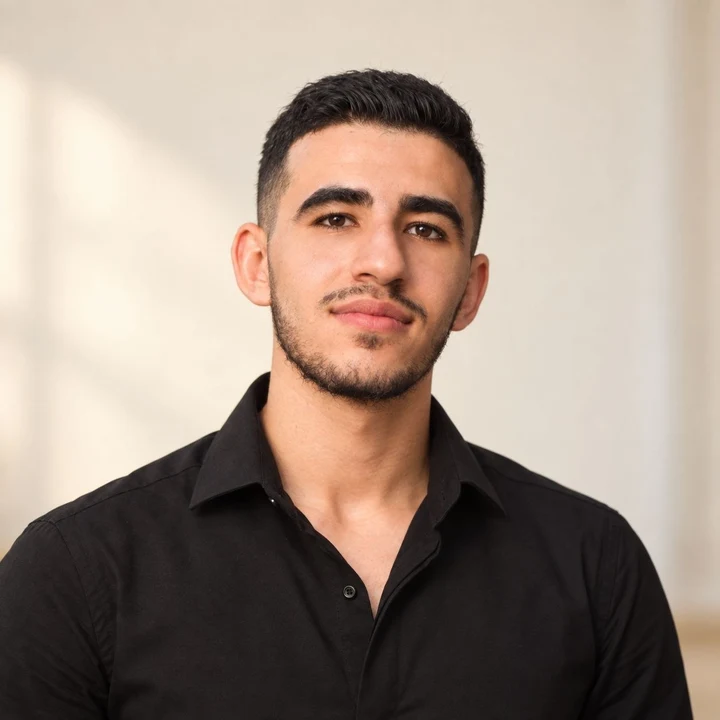
Your teacher
يوسف زيتون
Yousef is a Syrian-Lebanese Arabic teacher based in Lebanon, with four years of teaching experience.
Bring a voice note you’d love to understand, a greeting for someone you miss, or a sentence you want to read. Yousef helps you break it down, say it aloud and make it your own. Grammar comes up when it helps you say what you mean.
Meet Yousef in a free trialMonthly plans
Choose two, three or four lessons a week. Each monthly package covers four teaching weeks. All prices are in US dollars.
$64per month
8 lessons$8 per lesson
Keep a steady rhythm around work or study, with time to practise between lessons.
$84per month
12 lessons$7 per lesson
Bring new material into the week, revisit it, then try using it in a fresh conversation.
$96per month
16 lessons$6 per lesson
Get frequent speaking and reading practice ahead of a visit or a personal deadline.
Your free trial
Send a WhatsApp message or use the email form. A goal like “I want to understand my grandparents” is enough. We’ll reply to arrange a time.
In Fusha, you might sound out بَاب (door), or read a sentence if you know the letters. In Shami, try ordering a coffee and answering the next question.
Take away a word or phrase you used in the lesson and a suggestion for what to learn next. You decide whether to book another lesson.
Before you begin
Yes. In Fusha, we can start with the sound and shape of one letter. In Shami, you can start speaking by listening to a greeting and saying it back.
Choose Fusha (Modern Standard Arabic) if you want to read books, understand news, or write. Choose Shami (Levantine Arabic) if you want to talk with family, visit the Levant, or follow everyday conversation.
Bring something you’d like help with, such as a sentence you can read but find hard to explain, or a question you hear from relatives. We can use it as the starting point for your trial.
People speak varieties of Shami in Syria, Lebanon, Palestine and Jordan, and many Arabic speakers elsewhere are familiar with it. Learning Shami helps you notice shared words across dialects. How much you understand also depends on the region and what you’ve heard before.
Your trial is free to book and attend. We don’t ask for payment or card details. If you’d like to continue, choose a monthly plan and agree on your lesson times with Yousef.
Book your free trial
Tell us your goal or ask a question. We’ll help you choose between Fusha and Shami and find a time for your free online lesson.
Your trial is free. No payment or card needed.
Leave your details and we’ll reply to the address you enter.